
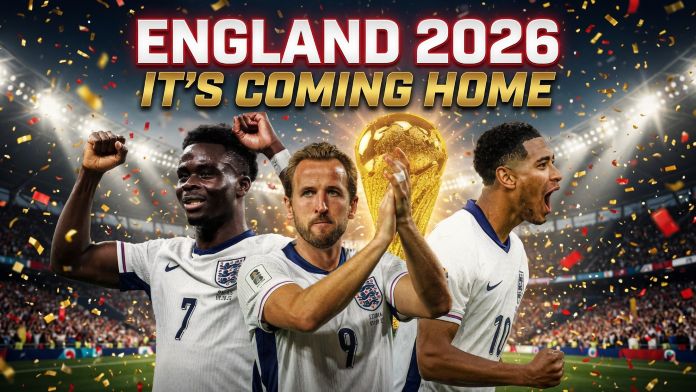
The 2026 FIFA World Cup is underway across North America, and while Spain and France enter as narrow favorites at around +450 to +500 odds, England sit as strong third favorites around +700.
Under Thomas Tuchel, this squad has the perfect blend of experience, peak talent, depth, and tactical structure to end 60 years of hurt. And we think the Three Lions are poised to finally bring the elusive trophy home.
Here’s a detailed, fact-based case for why and how England lifts the trophy.
The England Squad is a Golden Generation at Its Peak
Before the commencement of the tournament, the England manager, Thomas Tuchel named a 26-man squad that blends established stars with emerging talent.
Key names called up for the 2026 World Cup include:
- Goalkeepers: Jordan Pickford (Everton, ~84 caps), Dean Henderson (Crystal Palace), James Trafford (Man City).
- Defenders: John Stones (Man City), Marc Guéhi (Man City), Reece James (Chelsea), Ezri Konsa (Aston Villa), Dan Burn, Tino Livramento, Jarell Quansah, and others. Nine players are making their senior tournament debuts, injecting freshness.
- Midfield: Declan Rice (Arsenal), Jude Bellingham (Real Madrid), Kobbie Mainoo (Man Utd), Elliot Anderson (Nottingham Forest), Eberechi Eze (Arsenal), Jordan Henderson, Morgan Rogers (Aston Villa).
- Attack: Harry Kane (Bayern Munich, captain), Bukayo Saka (Arsenal), Marcus Rashford (Barcelona, on loan), Anthony Gordon (Barcelona), Ollie Watkins (Aston Villa), Ivan Toney (Al-Ahli), Noni Madueke (Arsenal).
Notable omissions like Cole Palmer, Phil Foden, and Trent Alexander-Arnold show Tuchel prioritizing system fit, chemistry, and balance over pure star power. This squad has immense depth, 22 players have won major trophies since 2024-25, and an average age around 27, hitting prime form together.
Harry Kane: The Clinical Finisher and Leader
Harry Kane is irreplaceable. In the 2025-26 season with Bayern, he scored 36 Bundesliga goals in 31 appearances (plus strong Champions League form), often cited with totals around 50+ across competitions in some reports, another Golden Boot-level campaign.
His movement, link-up play, penalty prowess, and aerial ability make him a nightmare. He’s England’s all-time top scorer and thrives in big tournaments.
England’s attack revolves around him. Recent friendlies (e.g., 3-0 vs Costa Rica) showed Arsenal players and Kane-linked combinations delivering goals. Without him, the team struggles, Tuchel knows this. Kane’s leadership and tournament experience (third World Cup) will be pivotal in knockouts.
Dynamic Attack: Saka, Bellingham, and Versatile Threats
- Bukayo Saka: Electric winger with pace, dribbling, and creativity. Arsenal’s star has delivered consistently (multiple Player of the Season nods historically, key contributions in 2025-26). His directness and set-piece delivery create chaos.
- Jude Bellingham: The complete midfielder. At 22-23, he’s a goal-scoring box-crasher (goals and assists in La Liga and UCL for Real Madrid). His energy, technique, and leadership drive transitions. Debates with Morgan Rogers for starts highlight squad depth.
- Support from Rashford’s pace, Watkins/Toney’s hold-up and finishing, Gordon/Madueke’s flair, and Eze’s creativity gives Tuchel massive flexibility in a 4-2-3-1 or 4-3-3.
This front line combines Premier League intensity with European pedigree. Qualifying was perfect: 8 wins, 22 goals scored, 0 conceded, showing clinical edge.
Midfield and Defense: Control and Solidity
Declan Rice anchors with world-class tackling and positioning (Arsenal move elevated him). Elliot Anderson adds poise. The unit controls games while Bellingham pushes forward.
Defense features experienced Stones/Guéhi partnerships, athletic full-backs (James, Livramento, Spence), and Pickford’s shot-stopping. It’s not the flashiest but functional under Tuchel’s compact, organized setup, prioritizing structure over individual flair in key moments.
Tuchel’s Tactics and Momentum
Tuchel brings Champions League-winning pedigree and a clearer tactical identity than predecessors: compact blocks, smart rotations, and exploiting transitions.
Recent form includes solid wins (3-0 Costa Rica, 1-0 New Zealand) despite some mixed results. The expanded 48-team format gives breathing room, and England’s group (L, with Croatia opener) is navigable.
Opta simulations give England strong quarterfinal and semifinal chances (~second-likeliest for quarters). They have the second-best chance among non-favorites to go far.
Read Also: World Cup 2026 Power Rankings: Spain Top List — Here Are Their Biggest Threats
How the Three Lions Will Neutralize the World’s Best in 2026
One of the biggest reasons England are serious contenders is their ability to match up against the planet’s elite attackers. Thomas Tuchel’s setup emphasizes structure, midfield control, and intelligent defending. Here’s a breakdown of how key Three Lions players could shut down superstars like Lionel Messi, Cristiano Ronaldo, and Kylian Mbappé.
Stopping Lionel Messi (Argentina)
Messi, even in his later years, remains a genius with the ball at his feet, dropping deep, creating, and delivering killer passes. But England’s midfield and defense are built to handle this.
- Declan Rice will be the primary disruptor. His positioning, tackling range, and ability to cover ground let him shadow Messi when he drops into midfield. Rice’s 2025-26 form at Arsenal showed him winning duels consistently while starting attacks. He cuts passing lanes and forces Messi into less dangerous areas.
- Jude Bellingham adds high-energy pressing and box-to-box dynamism. He can step up to challenge Messi physically or mark him in transitional moments, using his athleticism to limit space.
- John Stones and Marc Guéhi form a composed central defensive partnership. Stones excels at reading play and stepping out with the ball, while Guéhi’s strength and recovery pace handle any through balls. They’ll stay compact, denying Messi time on the ball in central zones.
- Reece James on the right provides intelligent tracking and can double up if needed. Tuchel’s compact blocks make it hard for Messi to find pockets of space, forcing him wider or deeper where England’s numbers overwhelm him.
England’s perfect qualifying record (22 goals scored, 0 conceded) shows they can neutralize creative threats through organization.
Containing Cristiano Ronaldo (Portugal)
Ronaldo, in what could be his final World Cup dance, still thrives on movement, aerial ability, and clinical finishing. Portugal rely on him for big moments, but England’s setup is well-equipped.
- Declan Rice again anchors, protecting the backline and limiting service into Ronaldo. His discipline prevents Portugal from building momentum through the middle.
- John Stones is excellent at dealing with aerial threats and reading Ronaldo’s runs. His positioning and timing in duels make him a nightmare for poachers.
- Harry Kane leads from the front but drops deep to help defensively, adding another body in midfield battles and pressing Portugal’s build-up.
- Full-backs like Reece James and Tino Livramento (or Djed Spence) stay tight on Portugal’s wide threats, reducing crosses that Ronaldo loves. Tuchel’s rotations keep the defense fresh, and England’s set-piece organization (both defending and attacking) matches Portugal’s.
Ronaldo’s age means he may not press as intensely, which England can exploit by controlling possession and tempo.
Neutralizing Kylian Mbappé (France)
Mbappé is the ultimate modern threat, explosive pace, direct dribbling, and finishing. He’s often called unstoppable in transitions, but England have the tools to contain him.
- Reece James or athletic full-backs provide pace and strength to track Mbappé’s runs. James’s recovery speed and tackling have historically troubled quick wingers/forwards.
- Marc Guéhi and John Stones offer a balanced partnership: Guéhi’s physicality wins duels, while Stones reads the game to intercept early. They avoid diving in, forcing Mbappé into crowded areas.
- Declan Rice and Jude Bellingham control the midfield, winning the ball high and denying France the transitions where Mbappé shines. Rice’s screening is world-class here.
- Bukayo Saka contributes defensively on the right, helping overload and press France’s build-up.
Tuchel’s tactics favor compact, organized defending that limits space behind the line, exactly what slows down pace merchants like Mbappé. England’s depth allows fresh legs in knockouts, wearing down opponents over 90+ minutes.
‘Football is Coming Home’
England have been finalists in recent Euros. This squad peaks at the right time, many in prime, others emerging. Tuchel avoids past pitfalls by emphasizing team over stars. In North America’s big stages, the Three Lions’ intensity, set-piece prowess, and Kane’s finishing will shine in high-pressure knockouts.
Path outline: Top Group L comfortably. Navigate favorable early knockouts with depth (rotations key in heat/humidity). Semis/final grind out results with Pickford heroics, midfield control, and Kane magic. A final vs. Spain/France/Brazil/Argentina? England’s balance wins it.
Prediction: England wins the 2026 World Cup. The stars align, talent, management, form, and that intangible hunger. 1966 will be repeated in 2026. It’s coming home.








Discussion about this post